Contemporary art in 2026: pixels, dust and billions — the great recomposition
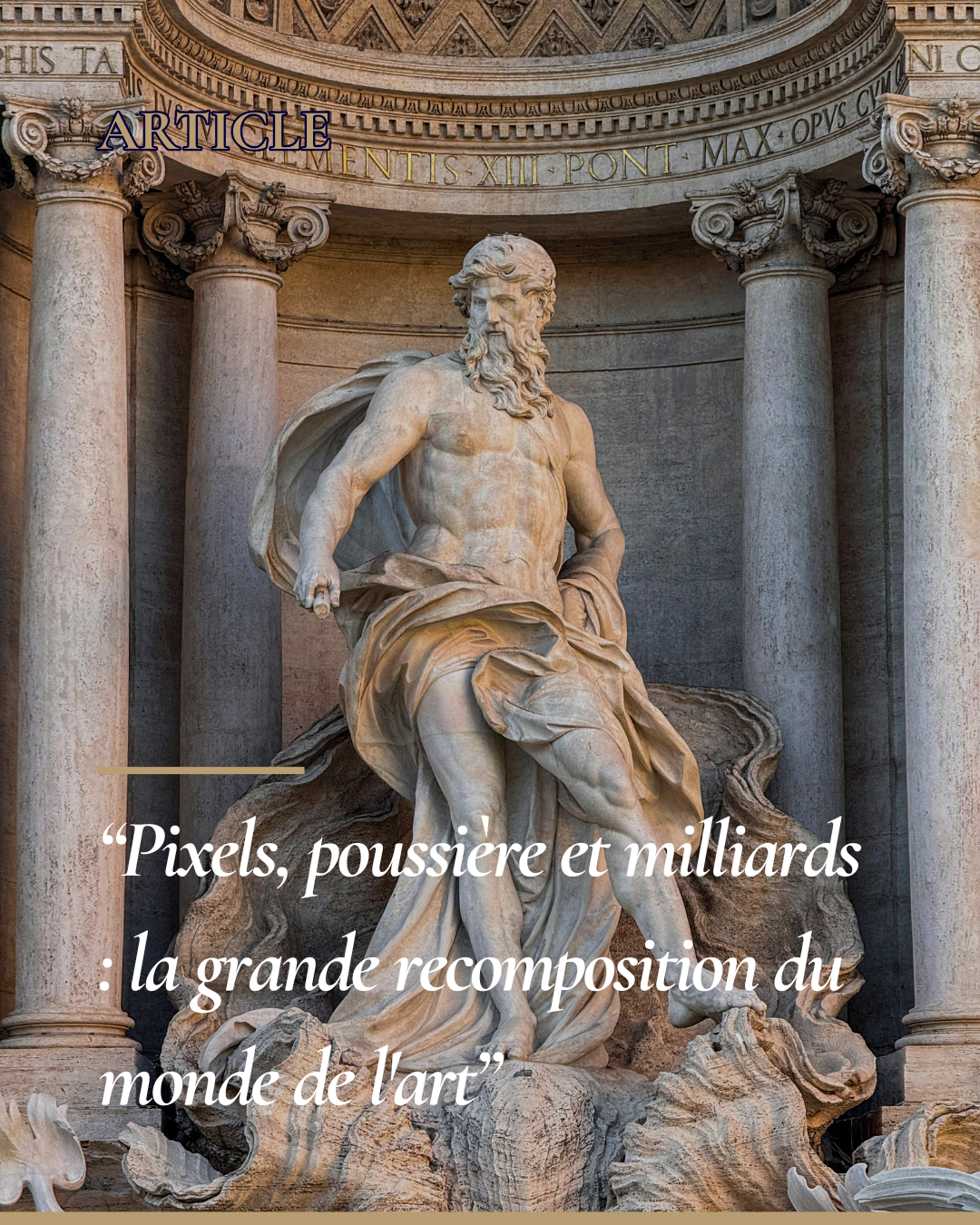
Three tectonic forces are confronting each other today before our eyes: the surge of art generated by AI, the spectacular revenge of the hand and the material, and the voracious financialization of mega-galleries.
Let's remember the thrill of October 2018: at Christie's, the Portrait of Edmond de Belamy, an algorithmic smear signed with a mathematical formula by the Obvious collective, soared to $432,500.
From tool to rival: the great misunderstanding
The public debate has been bogged down in a poorly posed question: “Can AI create?”
Real AI artists don't make pretty pictures
Let us distinguish, with the necessary cruelty.
Let's add the litigation, because it is colossal: lawsuits by image banks against the machine learning giants, revolt of looted illustrators, festival charters banning generated content.
And while the servers are heating up, what do we see triumphing in biennials, fairs and museums?
Ultra-materiality as an antidote
This was to be expected: as the image became free, unlimited and liquid, desire shifted to what resists.
A review of history in progress
This reversal has a scope that goes beyond aesthetics: it rehabilitates entire lineages of artists that the modernist, masculine, Western hierarchy, obsessed by the concept, had despised.
- Les institutions : les musées d'art moderne consacrent des rétrospectives entières au textile et à la céramique, hier reléguées aux musées d'arts décoratifs.
- Le marché : les cotes des grandes figures du fiber art et de la céramique d'auteur ont été multipliées en une décennie, rattrapant des pans entiers de la peinture.
- Les écoles : les ateliers terre, verre et textile des écoles d'art, désertés dans les années 2000, affichent complet — génération burn-out numérique oblige.
Tasty irony: it is the machine which has restored its nobility to the hand.
Above this aesthetic battlefield, another war is being played out, more subdued, more decisive.
The artist as a financial asset
The most disturbing symptom of this financialization bears a name that the industry pronounces with a grimace: flipping, the rapid purchase and resale of works by young artists whose prices soar in a few seasons before, often, collapsing.
The asphyxiated ecosystem — and its pockets of resistance
Mechanical consequence: the intermediate floor collapses.
So, diagnosis?
The answer is already emerging, implicitly, in everything we have observed: art is what engages a body, a time, a risk.