Marianne dreams of Seth at the National Assembly: analysis of an aesthetic and political shock
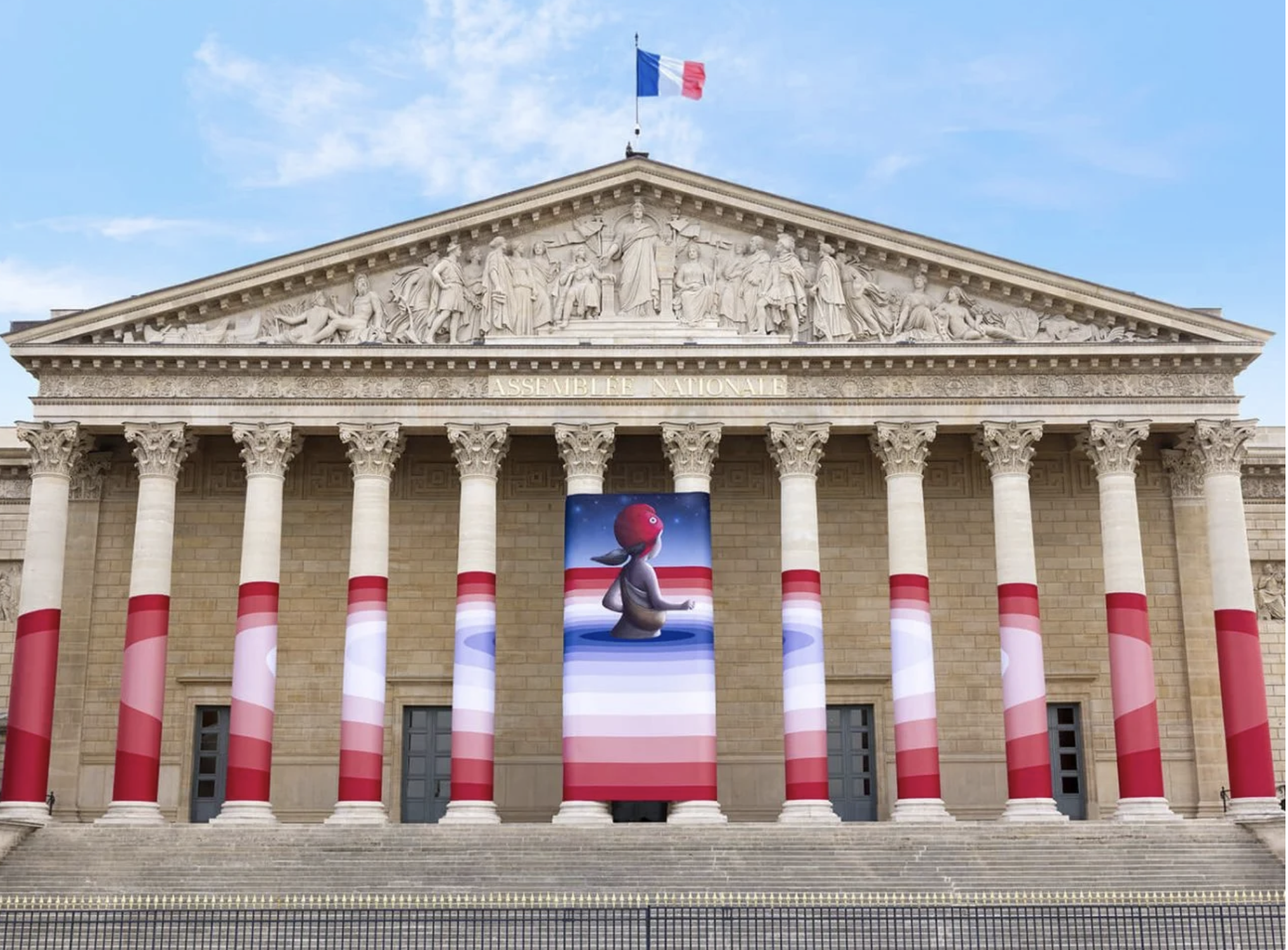
With the monumental installation “Marianne dreams” on the colonnade of the National Assembly, urban artist Seth brings childhood and graphic poetry to the heart of legislative power.
The visual event of this summer of 2026 was not nestled in the cozy white cube of a gallery in the Marais, nor under the glass roofs of the large private foundations in western Paris.
I. The clash of temporalities: childhood at the heart of the Republican marble
Visually, the telescoping is striking.
The erasure of features: the universal signature of Seth
Unlike classic representations of the Republic - from Eugène Delacroix's fiery Liberty Leading the People to the sculpted official busts that adorn the town halls of France - this Marianne does not have the features of a warrior woman, a severe matron or an allegorical muse.
This erasure of features is not a simple aesthetic coquetry;
The chromatic vortex facing the monochromy of the stone
The other aesthetic shock lies in the use of color.
This dynamic treatment creates a striking contrast with the gray and unchanging monochromy of the Palais-Bourbon stone.
II.
To understand the significance of “Marianne dreams”, it is necessary to place this gesture in the history of urban art and its complex relationships with public institutions.
From clandestine tag to public order: ambiguous legitimization
The journey of Julien Malland, alias Seth, is emblematic of this trajectory.
- Les prémices (2000-2010) : L'entrée discrète du street art dans les collections privées et les premières expositions thématiques dans les musées nationaux.
- L'institutionnalisation (2010-2020) : Les grandes commandes de fresques murales par les municipalités (notamment dans le 13e arrondissement de Paris) pour revitaliser le tissu urbain.
- La consécration (2020-2026) : L'occupation éphémère des façades des monuments historiques majeurs, transformant le patrimoine en espace de dialogue contemporain.
The historical antecedent: the Mariannes by Jean-Louis Debré (2003)
This is not the first time that the columns of the National Assembly have served as support for a reinterpretation of the republican figure.
However, Seth's intervention goes much further: she does not use documentary photography, but the filter of urban art and poetic illustration to carry out her semantic shift.
III.
Behind the apparent softness of Seth's lines and the freshness of his colors lies a very acute philosophical and political critique.
Childhood as a metaphor for the unfinished ideal
In Western political thought, the adult embodies accomplished reason, conformity to laws and integration into the social system.
By making Marianne a child who “dreams”, Seth reminds us that the Republic and its promises (Liberty, Equality, Fraternity) are not definitive achievements of which the Palais-Bourbon would be the passive guardian.
The concept of “heterotopia” applied to the colonnade
To analyze this work, we can invoke the concept of heterotopia developed by the philosopher Michel Foucault - that is to say a real place which is located outside of all places, a sort of space of mythical or real contestation of the space in which we live.
By affixing this monumental fresco on the columns of the National Assembly, Seth creates a visual heterotopia.
IV.
Like any major artistic intervention in public space, “Marianne dreams” sparks passionate debates within art criticism and the political spectrum.
Tensions between subversion and domestication
For a fringe of art criticism, Seth's invitation to the Palais-Bourbon raises the question of the "domestication" of street art.
Some see it as a clever political communication operation, aimed at softening the image of an institution often perceived as distant or rigid by citizens.
A work open to contemporary crises
Ultimately, the strength of “Marianne Dream” lies in its status as an open work.
Seth doesn't decide.