Self-portrait: why the “self” is so fascinating
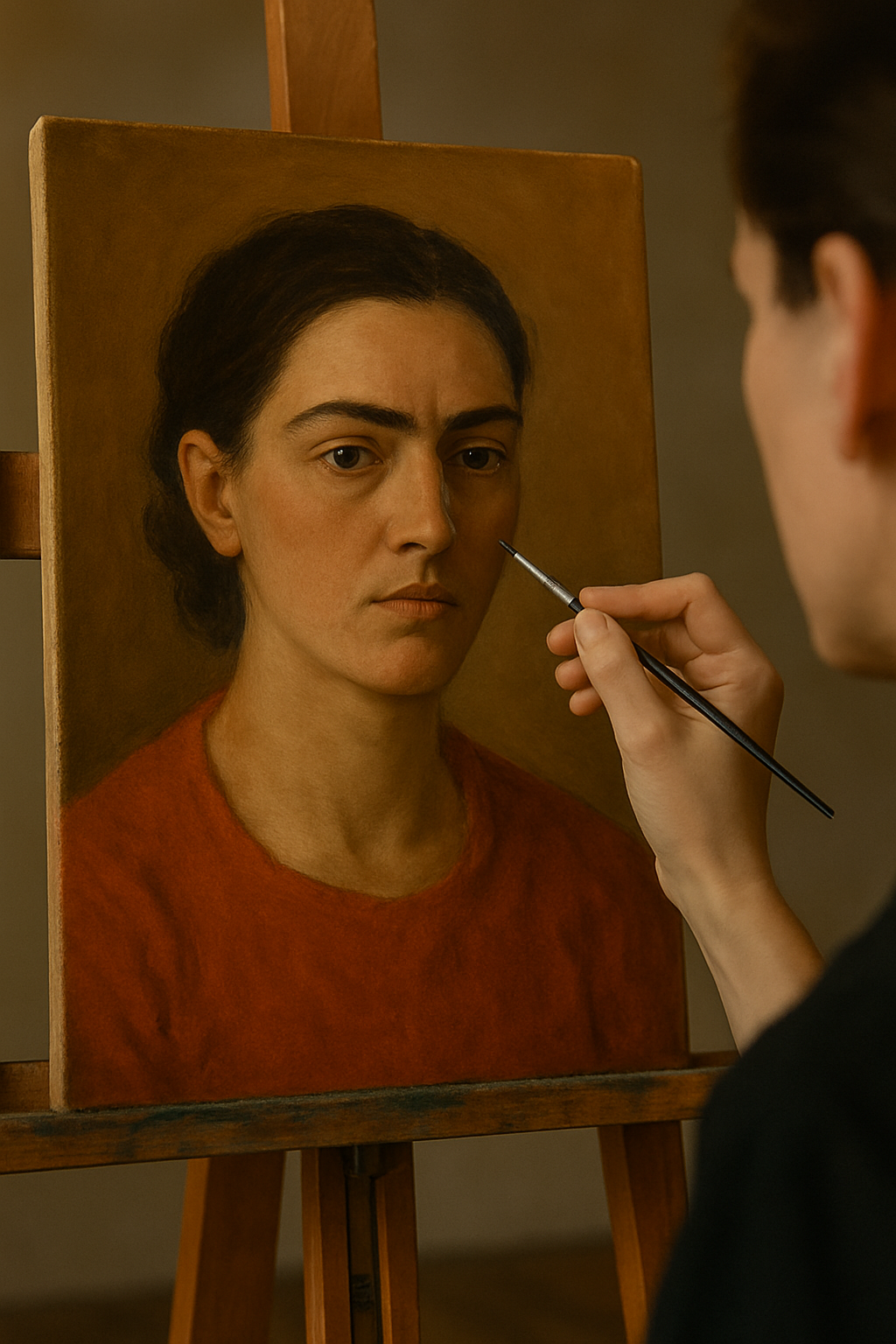
The self-portrait is not a simple exercise in style: it is the place where the artist puts himself most directly into play. From Frida Kahlo to Cindy Sherman, the “self” becomes at once an intimate mirror, an artistic manifesto and a powerful object of desire for collectors.
Why are collectors willing to fight for a face that the artist painted himself?
From Rembrandt to Frida Kahlo, from Van Gogh to Cindy Sherman, the self-portrait remains one of the most symbolically charged genres... and often among the most desired on the art market.
In this short format, we will see how the self-portrait is different from a “simple” portrait, why collectors project so much value into it, and what this can inspire today’s artists.
1. The self-portrait: more than a face, a story of identity
Historically, self-portraiture appeared massively from the 15th century, when artists had access to better mirrors and claimed their status as authors in their own right.
Three things make it so special:
Intimate by definition
The artist takes himself as subject.
A visual identity card
With Frida Kahlo, the self-portrait becomes a concentrate of her universe: physical pain, Mexican symbols, love/hate for Diego, political identity.
A mirror of its time
Des articles comme “10 masters of the self-portrait, from Frida Kahlo to Cindy Sherman” montrent bien que l’autoportrait change de sens selon les siècles : statut social chez Rembrandt, crise existentielle chez Van Gogh, critique des stéréotypes féminins chez Cindy Sherman, etc.
In summary: for a collector, a good self-portrait is not just “a face”.
2. When the market takes over the “self”
This symbolic charge is clearly reflected in the prices.
Frida Kahlo: a record self-portrait
In November 2025, El sueño (La cama), a self-portrait by Frida Kahlo dating from 1940, sold for $54.7 million at Sotheby’s in New York.
- l’œuvre la plus chère jamais vendue aux enchères par une femme artiste,
- le nouveau record pour l’art latino-américain.
The painting shows Kahlo asleep in a four-poster bed, with a skeleton wrapped in dynamite above her: an ultra-personal image, which condenses at the same time her pain, her awareness of death and her surrealist universe.
Cindy Sherman: the self-portrait as a conceptual device
Another example: Cindy Sherman, whose entire work is based on photographic self-portraits where she plays different roles.
In this case, the collector does not buy “the true face” of Sherman, but precisely his ability to transform, to expose and dismantle the stereotypes of female representation.
3. What this means for artists
These kinds of examples can give the illusion that it “is enough” to take a self-portrait to blow up the auction.
Self-portraiture works when it is necessary, not decorative.
For Kahlo, for Sherman, for Van Gogh, the self-portrait responds to a real urgency: to understand oneself, to put oneself at stake, to question one's identity.
The more coherent your universe is, the more a self-portrait becomes a “reading key”.
A good self-portrait can serve as a gateway to your work: it summarizes the tensions, the colors, the symbols that run through the rest of your practice.
Document, contextualize, connect.
Even if you are not in the sphere of millions, taking the time to: date, title, briefly explain a series of self-portraits can make a huge difference to the understanding of your work and therefore to its future value.
To extend: two records that change the market map
If this topic interests you, I recommend that you read:
- un autoportrait de Frida Kahlo
- et un portrait de Gustav Klimt ont redessiné les sommets du marché de l’art.
We understand that the self-portrait is not only an “intimate” genre: it is also a strategic terrain, where questions of memory, gender, geography… and value are replayed.